Crossover Symmetry Shoulder System
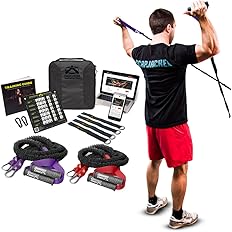
Crossover Symmetry is what serious college baseball programs install in their weight rooms when they want a single, standardized shoulder activation protocol. Two sets of calibrated resistance bands, anchor points for a wall or rack, a printed exercise chart laying out the exact sequence for pitchers, position players, and rehab progressions — and an online video library walking through proper form for every movement. It’s the same system you’ll find in dozens of D1 programs, MLB player-development complexes, and the better-resourced travel ball academies, because it solves a problem every program has: getting every athlete through the same activation routine in the same way every single day.
For a serious high school recruit, this is the shoulder care system you grow into once arm care becomes a daily habit, not an occasional one. Jaeger J-Bands cover the basics for a couple hundred days of throwing per year. Crossover Symmetry is what you install when you’ve decided you’re going to throw for the next decade — calibrated band tension at five different resistance levels, specific protocols for plyo throws, sprint conditioning, and post-throwing recovery, and a level of biomechanical specificity that’s been developed and refined by program directors at the highest levels of the sport. The system isn’t trying to replace J-Bands; it sits one tier up, with more equipment, more protocols, and a real installation footprint.
Two things to know before you buy. First: this is a permanent installation, not a portable tool. The system mounts to a wall, rack, or stud — you’ll need a dedicated space (garage, basement, or home gym) and probably an afternoon to set it up correctly. If you train at multiple locations or travel constantly, the J-Bands are still the right call for the road, with Crossover as the home base. Second: the bands themselves are color-coded by resistance, and the printed protocol tells you exactly which color to use for each exercise. Don’t improvise. The whole point of a system like this is that the activation load is calibrated for the movement — switching bands changes what muscles you’re actually training.
It earns the Edge Score of 86 because Crossover Symmetry is genuinely the gold standard for systematic shoulder care in baseball, and the D1 program adoption isn’t marketing — it’s real. But at $229, it sits in the awkward middle where most HS athletes don’t yet need the level of specificity it provides, and many won’t use it consistently enough to justify the price gap over J-Bands. If you have a dedicated training space, a parent who’ll hold you accountable to the protocol, and a real plan to play at the college level — this scores closer to 92. If you’re still trying to build the habit of doing band work in the first place, start with J-Bands and earn your way into this system.